
⚡ Quick Answer: How to Report a HIPAA Violation Anonymously
- Immediate Action / Statutory Deadline: File your complaint with the HHS Office for Civil Rights (OCR) within 180 days of discovering the privacy breach.
- Primary Regulatory Channel: Submit via the official HHS OCR Complaint Portal (ocrportal.hhs.gov) or call 1-800-368-1019 requesting anonymous filing status.
- Enforceable Legal Remedy: OCR imposes corrective action plans and civil monetary penalties up to $2,067,813 per calendar year tier against covered entities.
How Do I Report a HIPAA Violation Anonymously?
Report medical privacy violations anonymously to the Department of Health and Human Services Office for Civil Rights. Submit complaints regarding unauthorized disclosure of protected health information within 180 days of the incident. Federal investigators review submissions to enforce compliance, impose financial penalties, and mandate corrective actions at healthcare facilities.
- Gather Evidence: Collect dates, times, names of involved staff members, and specific details describing how the medical information was improperly accessed or shared.
- File Your Report: Use the OCR online complaint portal and select the option to keep your identity confidential during the initial submission process.
- Follow Up: Retain your assigned complaint tracking number to check the investigation status, though anonymity may limit direct updates from investigators.
{
“@context”: “https://schema.org”,
“@graph”: [
{
“@type”: “HowTo”,
“name”: “How to Report a HIPAA Violation Anonymously: OCR Privacy Guide”,
“totalTime”: “PT10M”,
“estimatedCost”: {
“@type”: “MonetaryAmount”,
“currency”: “USD”,
“value”: “0”
},
“step”: [
{
“@type”: “HowToStep”,
“position”: 1,
“name”: “Step 1”,
“text”: “Search the hospital or clinic website for the Privacy Officer / Compliance Officer contact.”
},
{
“@type”: “HowToStep”,
“position”: 2,
“name”: “Step 2”,
“text”: “Call the facility’s third-party anonymous compliance hotline (often powered by EthicsPoint or Navex).”
},
{
“@type”: “HowToStep”,
“position”: 3,
“name”: “Step 3”,
“text”: “Provide full factual details and obtain a Report Tracking Key to receive case updates without revealing your name.”
}
],
“description”: “Learn how to report a HIPAA violation anonymously to the HHS Office for Civil Rights. Master the 180-day deadline, whistleblower rules, and privacy filing.”
},
{
“@type”: “FAQPage”,
“mainEntity”: [
{
“@type”: “Question”,
“name”: “Can I get financial compensation if my HIPAA rights were violated?”,
“acceptedAnswer”: {
“@type”: “Answer”,
“text”: “HIPAA itself does not award financial settlements directly to victims; civil penalties collected by the OCR are paid to the federal government. However, you can use the OCR violation finding as evidence in a state court lawsuit for Invasion of Privacy, Negligence, or Breach of Confidentiality to recover compensatory damages.”
}
},
{
“@type”: “Question”,
“name”: “Who is NOT covered by HIPAA?”,
“acceptedAnswer”: {
“@type”: “Answer”,
“text”: “Employers, life insurance companies, workers’ compensation carriers, schools, and health apps (like commercial fitness trackers) are generally not covered by HIPAA unless they operate as a healthcare clearinghouse or business associate.”
}
},
{
“@type”: “Question”,
“name”: “What is an EHR Audit Trail?”,
“acceptedAnswer”: {
“@type”: “Answer”,
“text”: “Electronic Health Record (EHR) software (such as Epic or Cerner) maintains an immutable digital audit log recording every single user who opens, views, prints, or exports a patient’s chart, down to the exact millisecond. Privacy investigators use this log to prove unauthorized snooping.”
}
}
]
}
]
}
To report a medical privacy breach or unauthorized disclosure of Protected Health Information (PHI), file an official complaint with the HHS Office for Civil Rights (OCR) via the online portal at ocrportal.hhs.gov or call 1-800-368-1019 . You must file within 180 days of when you knew or should have known about the violation.
Learning how to report a HIPAA violation anonymously protects sensitive medical history, diagnosis records, and mental health notes from illegal disclosure, workplace snooping, and commercial exploitation. The Health Insurance Portability and Accountability Act (HIPAA) Privacy and Security Rules establish strict federal safeguards over Protected Health Information (PHI). While the Office for Civil Rights (OCR) does not investigate fully anonymous complaints without contact information, you can request strict whistleblower confidentiality, file through a legal proxy, or submit internal anonymous disclosures directly to a hospital’s Privacy Compliance Officer.
Under 45 CFR § 160.306, all HIPAA complaints must be filed with the OCR within 180 days of when the violation occurred or when you reasonably became aware of it. The OCR can waive the 180-day time limit only if you show “good cause” (such as being medically incapacitated or the covered entity deliberately concealing the breach).
HIPAA Violation Classification: Determining the Severity Tier
The HHS Office for Civil Rights classifies violations into 4 progressive culpability tiers with civil penalties ranging from $10050,000 per record.
Hospital employees accessing medical charts of family, coworkers, or celebrities without a clinical reason to know.
Discussing patient medical conditions in public waiting rooms, posting details on social media, or faxing records to wrong numbers.
Unencrypted laptops stolen, unpatched server databases breached by ransomware, or medical records discarded in regular trash.
Where to Report: Agency Escalation Matrix
Depending on who committed the violation, choose the governing agency to lodge your complaint.
- Focus: Primary federal regulator for all HIPAA covered entities & business associates.
- Portal:
ocrportal.hhs.gov/ 1-800-368-1019. - Power: Enforces Corrective Action Plans and multi-million dollar monetary penalties.
- Focus: Immediate internal compliance investigation and staff discipline.
- Channel: Hospital compliance hotline (allows 100% anonymous reports).
- Power: Employee termination, credential revocation, internal audit trail review.
- Focus: Professional licensing misconduct and state medical privacy laws.
- Channel: State Board of Medicine / State AG Consumer Protection.
- Power: Revokes doctor/nurse medical licenses and enforces state consumer fines.
Step-by-Step Guide to Filing a HIPAA Complaint
Follow these 5 steps to file with the federal government while protecting your confidentiality.

Step 1: Documenting the Breach Details & Covered Entity Identity
Before initiating a complaint, compile specific evidence of the violation:
- Covered Entity Details: Exact name of the hospital, clinic, pharmacy, health insurance plan, or doctor’s office.
- Date & Location: Specific date and department where the unauthorized disclosure occurred.
- Specific PHI Disclosed: Names, Social Security numbers, diagnoses, lab results, billing codes, or medical images involved.
- Perpetrator Identity: Names or titles of individuals who improperly viewed, shared, or mishandled the records.

Step 2: Submitting Anonymously to the Covered Entity’s Compliance Hotline
If you wish to remain 100% anonymous (especially as an employee or patient):
- Search the hospital or clinic website for the Privacy Officer / Compliance Officer contact.
- Call the facility’s third-party anonymous compliance hotline (often powered by EthicsPoint or Navex).
- Provide full factual details and obtain a Report Tracking Key to receive case updates without revealing your name.
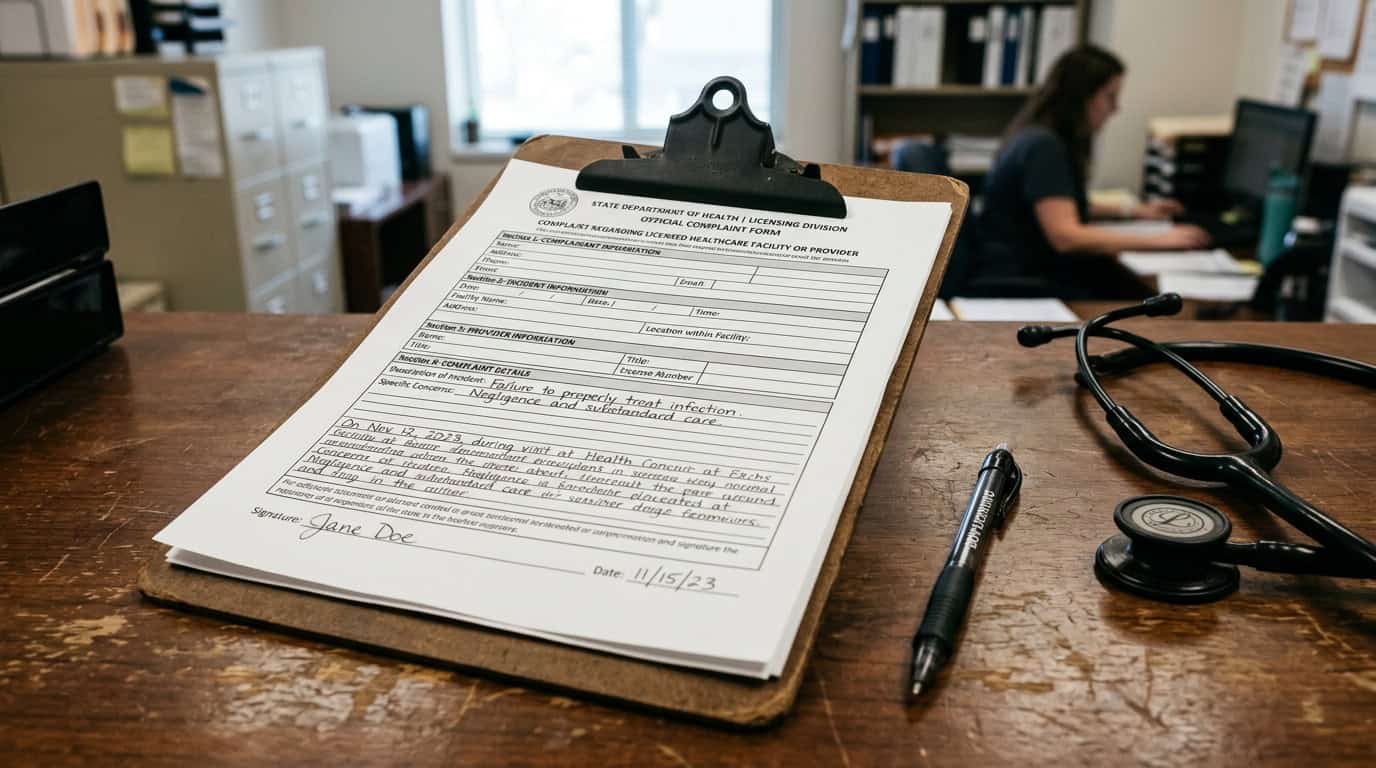
Step 3: Filing Online via the HHS OCR Complaint Portal
To initiate a federal investigation with the Department of Health and Human Services:
- Navigate to ocrportal.hhs.gov.
- Select “Health Information Privacy Complaint”.
- Complete the step-by-step intake describing the sequence of events and how your PHI was compromised.
- Under the Consent Section, you can elect to withhold consent for the OCR to release your name to the entity if revealing it is not strictly required to investigate.
Step 4: Exercising Whistleblower Anti-Retaliation Protections
Under 45 CFR § 160.316, covered entities are strictly prohibited from intimidating, threatening, coercing, or discriminating against anyone who files a HIPAA complaint or assists in an OCR investigation:
- If your employer retaliates, notify the OCR investigator immediately.
- Retaliation is a separate federal violation resulting in expedited enforcement action and independent labor lawsuits.
Step 5: Monitoring the OCR Investigation & Resolution Agreements
Once assigned an OCR Transaction Number:
- The OCR reviews the filing to verify jurisdiction and timeliness.
- If accepted, the OCR launches an investigation, requesting internal audit logs and electronic access records from the hospital.
- Resolutions result in mandatory Corrective Action Plans (CAP), staff retraining, and civil monetary settlements.
Evidence Preparation Checklist & Submission Roadmap
Document the specific PHI breached, staff involved, dates, and covered entity details.
Optionally report through hospital third-party compliance hotline for 100% anonymity.
Submit formal complaint at ocrportal.hhs.gov within the 180-day statutory window.
OCR conducts formal audit, mandates security remediations, and levies fines.
Formal HIPAA Privacy Violation Notification Template
When sending written notice to a hospital’s Privacy Compliance Officer or the OCR, use this formal complaint template:
TO: Privacy Compliance Officer / HHS Office for Civil Rights Intake
DATE: [Enter Date]
RE: Formal Complaint of Unauthorized Disclosure of Protected Health Information (PHI)
Covered Entity Name: [Hospital / Clinic / Medical Practice Name]
Facility Address: [Full Physical Address]
Dear Privacy Compliance Officer / OCR Investigator,
I am filing a formal complaint regarding an unauthorized breach and disclosure of Protected Health Information (PHI) in violation of the HIPAA Privacy Rule (45 CFR Part 160 and Part 164).
1. Date & Description of Violation:
On [Date], the following unlawful disclosure of medical records occurred:
– [Specify exact breach, e.g., ‘Hospital staff accessed patient records without clinical authorization and discussed diagnosis in a public cafeteria’ / ‘Medical records containing Social Security numbers were emailed to an unauthorized third party’].
2. Involved Parties & Affected Data:
– Disclosing Individual(s): [Name / Title / Department if known]
– Scope of PHI Disclosed: [e.g., Medical chart, diagnosis, lab reports, billing information]
3. Action Requested:
I request a formal internal compliance investigation, an audit of electronic access logs (EHR audit trail), and written confirmation of corrective actions taken to mitigate this privacy breach.
Respectfully submitted,
[Your Name or ‘Confidential Complainant’]
[Contact Phone & Email]

Common Myths vs. Legal Realities About HIPAA Complaints
Fact: HIPAA only governs “Covered Entities” (healthcare providers, health plans, clearinghouses) and their Business Associates.
While the OCR requires contact info to verify claims, you can instruct them to withhold your name from the entity during preliminary inquiries.
Fact: HIPAA does not contain a “private right of action.” Lawsuits must be filed under state privacy torts or breach of fiduciary duty laws.
Under 42 U.S.C. § 1320d-6, knowingly obtaining or selling PHI for commercial advantage carries up to 10 years in federal prison.
Frequently Asked Questions
Can I get financial compensation if my HIPAA rights were violated?
HIPAA itself does not award financial settlements directly to victims; civil penalties collected by the OCR are paid to the federal government. However, you can use the OCR violation finding as evidence in a state court lawsuit for Invasion of Privacy, Negligence, or Breach of Confidentiality to recover compensatory damages.
Who is NOT covered by HIPAA?
Employers, life insurance companies, workers’ compensation carriers, schools, and health apps (like commercial fitness trackers) are generally not covered by HIPAA unless they operate as a healthcare clearinghouse or business associate.
What is an EHR Audit Trail?
Electronic Health Record (EHR) software (such as Epic or Cerner) maintains an immutable digital audit log recording every single user who opens, views, prints, or exports a patient’s chart, down to the exact millisecond. Privacy investigators use this log to prove unauthorized snooping.
- HHS Office for Civil Rights: Health Information Privacy Portal — HHS.gov HIPAA Complaint Guide
- OCR Complaint Portal: Direct Online Filing Portal — OCR SmartScreen Complaint Portal
- Federal Statute: HIPAA Privacy and Security Rules (45 CFR Parts 160 & 164) — Electronic Code of Federal Regulations
Before You Go: Citizen Protection Protocol
Protecting yourself against unlawful practices requires swift action, methodical documentation, and strict adherence to statutory deadlines. Preserve all original agreements, maintain contemporaneous call notes, and send formal correspondence via certified mail with return receipt requested.
HowToReport.org is an independent educational site — not a government agency. We link to official .gov and .org sources, but we cannot file a complaint for you or give legal advice. Read our full Legal Disclaimer & Safe Harbor →
Related Statutory Reporting Guides & Citizen Protections
Official step-by-step reporting protocols in this regulatory category.

Official sources
Use these official channels for your complaint — verify details on the agency site before you submit.
- HHS Office for Civil Rights — 1-800-368-1019 (Mon–Fri 8am–5pm ET)
- Official reporting portal
What happens next
- Most agencies send an acknowledgment or reference number — save it with your copies.
- Investigations vary by agency; complex cases can take weeks or months.
- If you do not hear back within the timeframe listed on the agency site, follow up in writing.
- Keep reporting to additional agencies if your issue crosses categories (for example, fraud plus billing).
1 thought on “How to Report a HIPAA Violation Anonymously: OCR Privacy Guide”