
⚡ Quick Answer: How to Report a Moving Company Scam & Hostage Load
- Immediate Action / Statutory Deadline: Invoke the federal 110% Rule (49 C.F.R. § 375.407) and tender 100% of a binding estimate or 110% of a non-binding estimate; demand immediate delivery and request local police civil standby if the mover holds possessions hostage.
- Primary Regulatory Agency: Federal Motor Carrier Safety Administration (FMCSA National Consumer Complaint Database at protectyourmove.gov) and your State Attorney General Consumer Protection Division.
- Statutory / Legal Remedy: Immediate release of household goods, civil fines up to $10,000+ per day under 49 U.S.C. § 14915, suspension of DOT operating authority, and civil damages.
When rogue moving brokers demand cash-only ransoms exceeding written estimates under threat of dumping household goods, interstate extortion and wire fraud reporting channels apply. For forensic scam indicators, fake payment alerts, and digital fraud prevention checklists, review the full advisory on our sister publication: Reporting Interstate Fraud & Extortion to Federal Authorities →
How Do I Report Moving Company Scam?
To report a moving company scam, file a formal complaint with the Federal Motor Carrier Safety Administration. Federal investigators review these cases to penalize fraudulent operators who hold consumer goods hostage. Exposing corrupt movers prevents other families from experiencing extortion during their relocation process.
- Gather Evidence: Collect the bill of lading, estimates, payment records, and communication logs with the company.
- File Your Report: Submit your complaint via the FMCSA National Consumer Complaint Database online portal.
- Follow Up: File concurrent complaints with the Better Business Bureau and your state attorney general.
Moving across the country is stressful enough without arriving at your new home only to have rogue movers lock your furniture inside a semi-truck and demand an extra $3,000 to $8,000 in cash. “Hostage load” schemes have surged over the past five years, orchestrated by predatory moving brokers and unlicensed rogue carriers who lure consumers with rock-bottom online quotes, only to extort them once their life possessions are secured behind a padlock.
Interstate household goods transportation is governed by strict federal statutes enforced by the Federal Motor Carrier Safety Administration (FMCSA) and the U.S. Department of Transportation (USDOT). Knowing the federal 110% Rule and exact extortion reporting mechanisms will protect your assets and compel carriers to release your cargo.

Hostage Freight Emergency Intervention Protocol
Step 1: Understand and Assert the Federal 110% Rule
The single most powerful weapon in interstate moving disputes is federal regulation 49 CFR § 375.407, commonly known as the Federal 110% Rule. Under federal law:
- Non-Binding Estimates: If you signed a non-binding estimate, the mover must deliver and unload all of your household goods upon your payment of no more than 110% of the original estimated cost. The carrier cannot demand the remaining balance on delivery day; they are required by federal law to defer billing for the remaining balance for at least 30 calendar days post-delivery.
- Binding Estimates: If you have a binding estimate (guaranteed quote), the carrier must deliver and unload all goods upon payment of exactly 100% of the binding estimate. Zero surcharges are permitted unless a formal revised estimate was signed in writing prior to loading.

Step 2: Request Local Police “Civil Standby” Assistance
If the moving truck driver locks the roll-up door and threatens to transport your furniture to an undisclosed warehouse unless you pay thousands in extra cash, do not engage in physical confrontation. Call local non-emergency dispatch (or 911 if the driver is aggressive or attempting to flee with your personal property):
- Inform dispatch: “I have a moving carrier committing a federal hostage freight violation at my residence under 49 U.S.C. § 14915. The driver is refusing to release our essential furniture and medications despite tender of full statutory payment. I request an officer for a civil standby to inspect the Bill of Lading.”
- While police officers often initially claim “this is a civil matter,” showing the responding officer the physical Bill of Lading and a printout of 49 U.S.C. § 14915 (which classifies holding household goods hostage as a federal crime carrying $10,000/day penalties) frequently compels drivers to unlock the truck on the spot rather than face criminal citations or impoundment.
Moving Fraud Regulatory Authorities & Reporting Portals
Step 3: Deliver the Formal Certified Mail Freight Release Demand
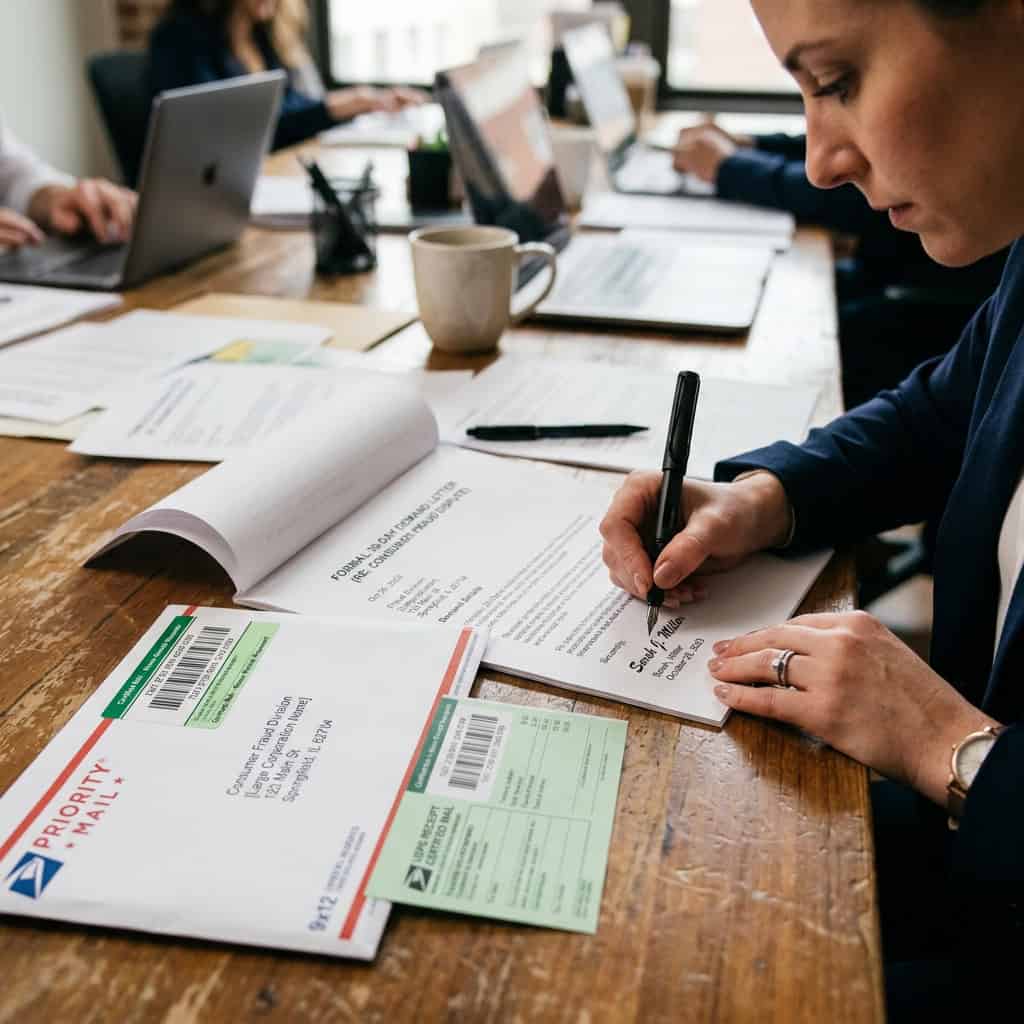
If your cargo has already been transported to an unknown storage facility or warehouse, you must immediately transmit a formal written demand. Send this letter via USPS Certified Mail with Return Receipt Requested and transmit an identical copy via email to the carrier’s registered agent.
Emergency Freight Release Demand & FMCSA 110% Rule Carrier Violation Notice
Governing Legal Authority: 49 U.S.C. § 14915 & 49 CFR Part 375
Instructions: Send via USPS Certified Mail with Return Receipt Requested. Retain the stamped green card and postal receipt to establish an unassailable evidentiary record for administrative complaints or civil claims.
SENT VIA USPS CERTIFIED MAIL — RETURN RECEIPT REQUESTED
Certified Mail Tracking No.: [Insert 20-Digit USPS Tracking #]
AND TRANSMITTED VIA CERTIFIED ELECTRONIC MAIL
To:
[Moving Company / Interstate Motor Carrier Legal Name]
[Registered Agent / Operations Manager]
[Carrier Physical Address]
[City, State, ZIP Code]
USDOT Number: [USDOT #] | MC/FF Number: [MC #]
Copy To:
Federal Motor Carrier Safety Administration (FMCSA)
Commercial Enforcement & Investigations Division
1200 New Jersey Avenue SE, Washington, DC 20590
RE: EMERGENCY STATUTORY DEMAND FOR IMMEDIATE RELEASE OF HOUSEHOLD GOODS (49 U.S.C. § 14915 & 49 CFR PART 375 — FMCSA 110% RULE VIOLATION)
Bill of Lading / Order for Service No.: [Order #] | Shipper Name: [Your Full Name]
Origin: [Origin Address] | Destination: [Destination Address] | Non-Binding Estimate: $[Amount]
To the Operations Management of [Moving Carrier Name]:
This letter constitutes an EMERGENCY STATUTORY DEMAND under federal transportation law, 49 U.S.C. § 14915 and 49 CFR § 375.407, demanding the immediate, unconditional delivery and release of all household goods currently held hostage by your company under Bill of Lading No. [Order #].
FACTUAL SUMMARY OF FEDERAL VIOLATIONS:
1. Violation of Mandatory 110% Rule (49 CFR § 375.407): Prior to loading, your company provided a non-binding written estimate totaling $[Estimate Amount]. Upon arriving at destination on [Date], your driver refused to unload our household goods unless paid $[Demanded Amount], which represents [X]% of the original estimate. Under federal law, a carrier is statutorily required to relinquish possession of all household goods upon payment of no more than 110% of the non-binding estimate ($[110% Amount]).
2. Unlawful Hostage Freight (49 U.S.C. § 14915): Withholding delivery to compel payment in excess of 110% of a non-binding estimate constitutes illegal hostage freight. Under 49 U.S.C. § 14915(a)(1), any carrier that fails to release household goods faces mandatory federal civil penalties of not less than $10,000 for each violation, plus $10,000 for each day the violation continues, as well as suspension of federal operating registration.
3. Deceptive Surcharges & Shifting Contracts: Charges for “long carries,” “stairs,” and “shuttle fees” were never disclosed in writing prior to signing the Order for Service and violate 49 CFR § 375.501.
FORMAL TENDER & FINAL NOTICE:
The shipper hereby formally tenders the full 110% statutory amount of $[110% Amount] via guaranteed funds (cashier’s check / verified postal money order). Demand is made that you schedule and execute delivery of all goods within forty-eight (48) hours of receipt of this notice.
Failure to deliver within 48 hours will result in the immediate escalation of our formal complaint with the FMCSA National Consumer Complaint Database (NCCDB), filing of a criminal extortion report with local law enforcement to arrange an on-site peace officer escort, and referral to the Consumer Protection Division of the State Attorney General.
Govern yourselves accordingly.
Sincerely,
____________________________________________
[Your Full Legal Name]
[Your Current Telephone Number]
[Your Current Email Address]
⚖️ Facing Damages or Unreturned Funds Under $25,000?
Check your state small claims court dollar ceiling, statutes of limitations, and attorney representation rules.
Step 4: File Official Complaints with FMCSA and State Regulators
Log into the Federal Motor Carrier Safety Administration National Consumer Complaint Database (NCCDB) at protectyourmove.gov. File a formal complaint detailing:
- The Carrier’s USDOT Number and MC/FF Number (found on the top of your Bill of Lading).
- The Broker’s name (if you booked through a third-party intermediary).
- The original written estimate vs. the demanded ransom amount.
- The physical location where your goods were last seen or stored.
FMCSA consumer protection investigators review hostage load complaints with high priority. Under the federal Safe, Accountable, Flexible, Efficient Transportation Equity Act, federal investigators have statutory authority to revoke a carrier’s interstate operating authority and levy civil penalties of $10,000+ per violation.

Moving Company Fraud Common Misconceptions
If a rogue interstate mover inflates your binding estimate and refuses to unload your household goods, follow our emergency protocol on How to Report Moving Company Hostage Freight & Extortion.
Frequently Asked Questions
What is the difference between a moving broker and a moving carrier?
A moving broker is a sales company that sells you an estimate and takes a deposit, but does not own trucks or employ movers. They sell your job to an independent motor carrier. You must verify that both the broker and the carrier are licensed with the FMCSA at protectyourmove.gov.
How long do I have to file an insurance claim for broken furniture?
Under federal statute (49 U.S.C. § 14706), you have a minimum of nine (9) months from the date of delivery to file a written freight claim for damaged or lost items with the carrier. The carrier must acknowledge receipt within 30 days and pay or deny the claim within 120 days.
Can a rogue mover legally auction my goods in storage?
No. While carriers possess a statutory carrier lien for authorized freight charges, exercising a lien while in active violation of the federal 110% Rule constitutes criminal conversion and auto extortion. You can obtain an immediate emergency injunction from a state or county court to halt any auction sale.
What if the move was entirely within one state?
If your move occurred entirely within one state (an intrastate move), federal FMCSA regulations do not apply. Instead, jurisdiction rests with your State Public Utilities Commission (PUC), State Department of Transportation, or State Attorney General Consumer Protection Division. Most states enforce strict tariff rate caps and prohibit hostage loads under state consumer protection statutes.
Official Regulatory Authorities & Governing Statutes
- FMCSA Protect Your Move (USDOT Official Oversight Portal)
- FMCSA National Consumer Complaint Database (NCCDB)
- 49 U.S.C. § 14915 (Civil and Criminal Penalties for Holding Household Goods Hostage)
- 49 CFR Part 375 (Transportation of Household Goods in Interstate Commerce; Consumer Protections)
Before You Go: Citizen Protection Protocol
Protecting yourself against unlawful practices requires swift action, methodical documentation, and strict adherence to statutory deadlines. Preserve all original agreements, maintain contemporaneous call notes, and send formal correspondence via certified mail with return receipt requested.
HowToReport.org is an independent educational site — not a government agency. We link to official .gov and .org sources, but we cannot file a complaint for you or give legal advice. Read our full Legal Disclaimer & Safe Harbor →
Damages Under ,000? Check Your State Small Claims Limit
If administrative complaints fail to recover your financial losses, you can sue in local small claims court without expensive attorney fees. Select your state below for instant dollar limits and statutory deadlines:
Related Statutory Reporting Guides & Citizen Protections
Official step-by-step reporting protocols in this regulatory category.



What happens next
- Most agencies send an acknowledgment or reference number — save it with your copies.
- Investigations vary by agency; complex cases can take weeks or months.
- If you do not hear back within the timeframe listed on the agency site, follow up in writing.
- Keep reporting to additional agencies if your issue crosses categories (for example, fraud plus billing).
2 thoughts on “How to Report a Moving Company Scam: Hostage Load Guide”