
⚡ Quick Answer: How to Report 1099 Worker Misclassification
- Immediate Action & Statutory Deadlines: Secure work schedules, email directives, and 1099 forms proving employer control; file within the 2-year FLSA statute of limitations (extended to 3 years for willful violations under 29 U.S.C. § 255).
- Primary Regulatory Enforcement Agencies: U.S. Department of Labor Wage & Hour Division (DOL WHD), Internal Revenue Service (IRS Form SS-8 Worker Status Determination), and your State Labor Commissioner / Department of Labor.
- Statutory & Legal Remedies: Recovery of 100% unpaid overtime premiums, minimum wage back pay, an equal amount in mandatory liquidated damages (29 U.S.C. § 216(b)), and employer FICA/Medicare tax re-allocation via IRS Form 8919.
Across the United States, employers routinely misclassify ordinary employees as “1099 independent contractors” to evade minimum wage laws, avoid overtime premiums, and offload their legal share of Medicare and Social Security payroll taxes onto workers. Simply signing a document labeled “Independent Contractor Agreement” or accepting payment reported on IRS Form 1099-NEC does not make you a legal contractor. Federal and state labor laws determine employment status based on the economic reality of your daily work, not employer labels.
When an employer sets your daily work schedule, dictates your specific tasks, requires you to follow company operating procedures, provides your equipment, or prohibits you from working for competitors, you are legally an employee under the Fair Labor Standards Act (FLSA). Misclassified workers are entitled to recover unpaid overtime, minimum wage back pay, expense reimbursements, and statutory liquidated damages. This guide details how to build an airtight evidence file, file formal complaints with the U.S. Department of Labor and the IRS, and protect against unlawful employer retaliation.
If your employer suspects an investigation or you raise classification questions, they may pressure you to sign an updated arbitration agreement, retroactive liability waiver, or revised independent contractor agreement. Do not sign. Under the FLSA, statutory rights to overtime and minimum wage cannot be privately waived or signed away without court or DOL approval.
Understanding Worker Misclassification: Legal Definitions & The Economic Reality Test
The U.S. Department of Labor and federal courts apply the Economic Reality Test under 29 CFR Part 795 to determine whether a worker is an employee or an independent contractor. Unlike common law agency rules, the economic reality standard examines whether the worker is economically dependent on the employer for their livelihood or is truly in business for themselves.
Federal regulations evaluate six core factors without any single factor being dispositive:
- Opportunity for Profit or Loss Depending on Managerial Skill: Genuine independent contractors negotiate their rates, accept or reject specific jobs, hire assistants, and market their services to other clients. If your earnings depend solely on the hours scheduled or tasks assigned by the company, you are an employee.
- Investments by the Worker and the Employer: A contractor makes capital investments in tools, facilities, equipment, or business licenses to support an independent commercial enterprise. Routine personal equipment (like a personal laptop or car used for deliveries) does not constitute capital business investment.
- Degree of Permanence of the Work Relationship: Independent contractor engagements are typically project-based, seasonal, or sporadic. Continuous, indefinite, or full-time relationships indicate an employee status.
- Nature and Degree of Control: If the employer controls your working hours, sets mandatory shift times, supervises how you perform tasks, requires uniforms, restricts working for competitors, or reserves the right to discipline you, they exercise employer control.
- Extent to Which the Work Performed is an Integral Part of the Employer’s Business: If the work you perform is central, critical, or essential to the company’s primary product or service (e.g., drivers for a delivery firm, writers for a content agency, paralegals for a law practice), you are an employee.
- Skill and Initiative: Specialized technical or trade skills indicate contractor status only when combined with business initiative to build an independent trade. Applying specialized skills under direct company instruction points to employee status.
Economic Reality Test vs. The Strict State ABC Test
| Legal Standard | Governing Jurisdictions | Core Legal Test | Burden of Proof |
|---|---|---|---|
| Federal FLSA Standard | All U.S. Federal Courts & U.S. DOL | 6-Factor Economic Reality Test: Totality of circumstances assessing whether worker is economically dependent on the employer. | Balanced analysis of control, profit/loss, investment, and permanence. |
| State “ABC” Test | California (AB 5 / Labor Code § 2775), New Jersey, Massachusetts, Illinois | Worker is presumed an employee unless employer proves ALL 3 prongs: (A) Free from control, (B) Work is outside core business, (C) Customarily engaged in independent trade. | Heavy employer burden. Failing any single prong establishes statutory employee status. |
| IRS Common Law Rules | Federal Tax Code (IRS Form SS-8) | 3 Categories: Behavioral control (instructions, training), Financial control (expenses, equipment), Type of relationship (benefits, written terms). | IRS issues binding determination for federal employment tax reallocation. |
Where to Report: Multi-Agency Jurisdiction & Escalation Strategy
Worker misclassification violates multiple federal and state statutes simultaneously. Filing strategic complaints across regulatory bodies maximizes recovery of unpaid wages, corrects payroll tax burdens, and triggers state unemployment insurance protection.
Multi-Agency Worker Misclassification Escalation Roadmap
U.S. DOL Wage & Hour: File formal wage claim for 1.5x overtime premiums, minimum wage differentials, and 100% liquidated damages under 29 U.S.C. § 216.
IRS Form SS-8 & 8919: Request official federal employee determination. Pay only your 7.65% employee FICA share, forcing employer to pay the other 7.65%.
State Labor Commissioner: File state wage claim for statutory meal/rest break penalties, waiting-time penalties, and unemployment insurance coverage.
Small Claims or Civil Court: File small claims action for unreimbursed business expenses, mileage, and unpaid compensation under statutory limits.
Step-by-Step Guide to Filing Your Misclassification Report
Step 1: Gathering and Preserving Crucial Evidence
Government investigators and civil judges require documentary proof of the employer’s day-to-day behavioral and financial control. Before notifying your employer or submitting a complaint, quietly compile your evidence folder outside company computer systems.
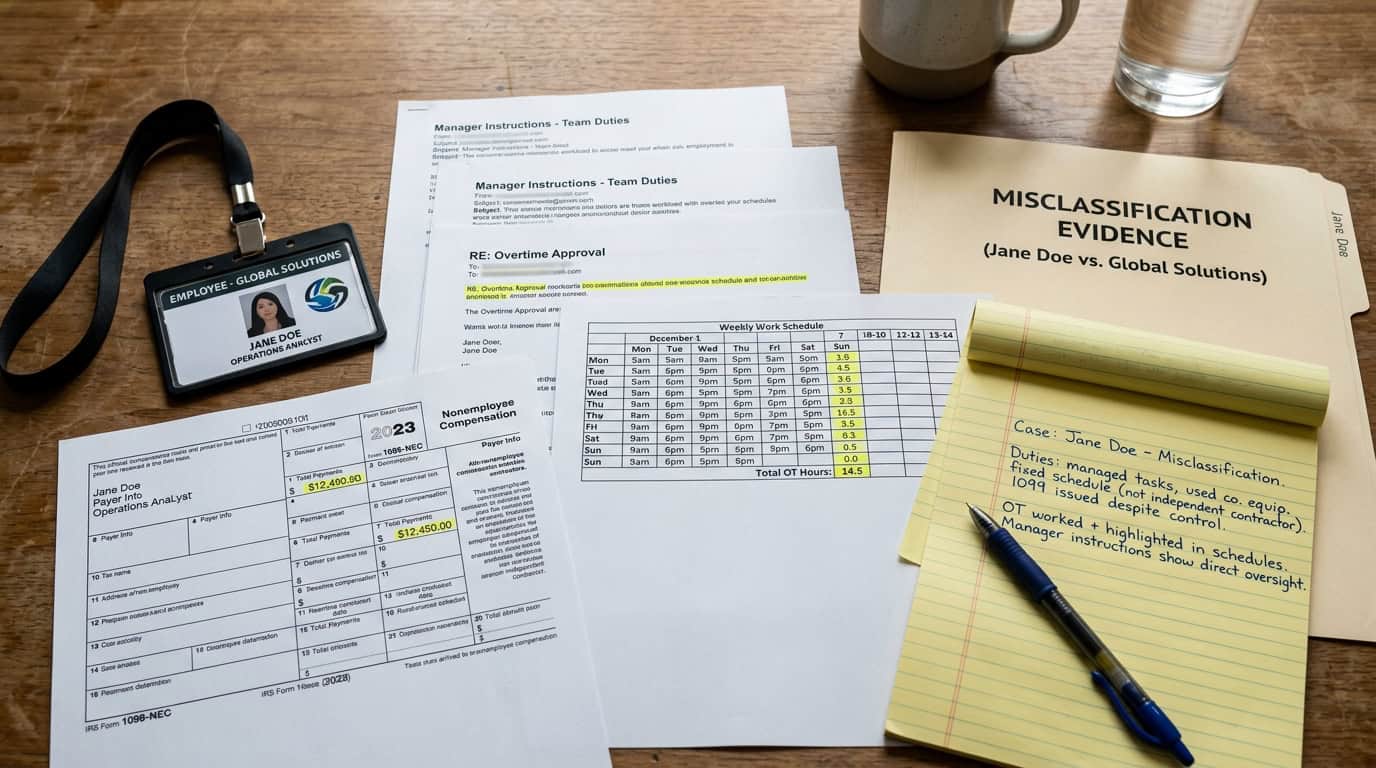
Your evidence assembly must document five essential areas:
- Written Instructions & Control Directives: Export emails, text messages, Slack messages, or printed memos where supervisors mandate arrival times, meal break windows, procedural checklists, uniform rules, or disciplinary warnings.
- Time and Attendance Records: Keep a personal, contemporaneous log of exact hours worked each day. Save company shift schedules, login/logout timestamps, access card logs, and GPS or dispatch logs demonstrating that you worked over 40 hours in specific workweeks.
- Payment Records & Tax Documents: Gather all IRS Form 1099-NEC and 1099-MISC forms, bank direct deposit statements, company payment vouchers, and written contractor agreements. Highlight any arbitrary pay deductions for uniform fees, insurance, or processing fees.
- Exclusivity & Integration Proof: Save emails showing you were prohibited from taking on outside clients or required to sign a non-compete clause. Save company org charts, staff directories, or business cards showing your role within the company.
- Unreimbursed Business Expenses: Collect receipts, mileage logs, cell phone bills, and equipment invoices that you were forced to pay out-of-pocket for company business.
Step 2: Submitting Your Complaint to the U.S. Department of Labor (WHD)
The U.S. Department of Labor Wage and Hour Division (WHD) enforces federal minimum wage and overtime protections under the FLSA. The WHD conducts on-site employer audits, interviews coworkers, and can compel the employer to pay back wages directly without requiring you to hire an attorney.

Follow these steps to file with the DOL WHD:
- Contact the WHD Intake Center: Call the national toll-free helpline at 1-866-487-9243 (1-866-4-USWAGE) or visit your local DOL Wage and Hour Division district office. Complaints can be initiated over the phone or online through the DOL worker portal.
- Confidentiality Protection: Explicitly inform the intake specialist if you are currently employed and request that your name be kept strictly confidential. The DOL does not reveal complainant identities to employers during routine workplace investigations.
- State the Exact Statutory Violations: Detail that the employer misclassified you as a 1099 independent contractor, failed to pay the statutory 1.5x overtime premium for hours worked beyond 40 per week, and controlled your daily work hours and methods.
- Secure Your DOL Case Tracking Number: Request your official DOL investigation case number and the direct phone extension of the assigned investigator.
Step 3: Reclassifying Your Taxes via IRS Form SS-8 and Form 8919
When an employer classifies you as a 1099 contractor, they fail to pay their required 7.65% share of Federal Insurance Contributions Act (FICA) taxes (6.2% Social Security + 1.45% Medicare). Instead, they force you to pay the entire 15.3% Self-Employment Tax (SECA) on Schedule SE. You can halt this tax shift through the IRS.
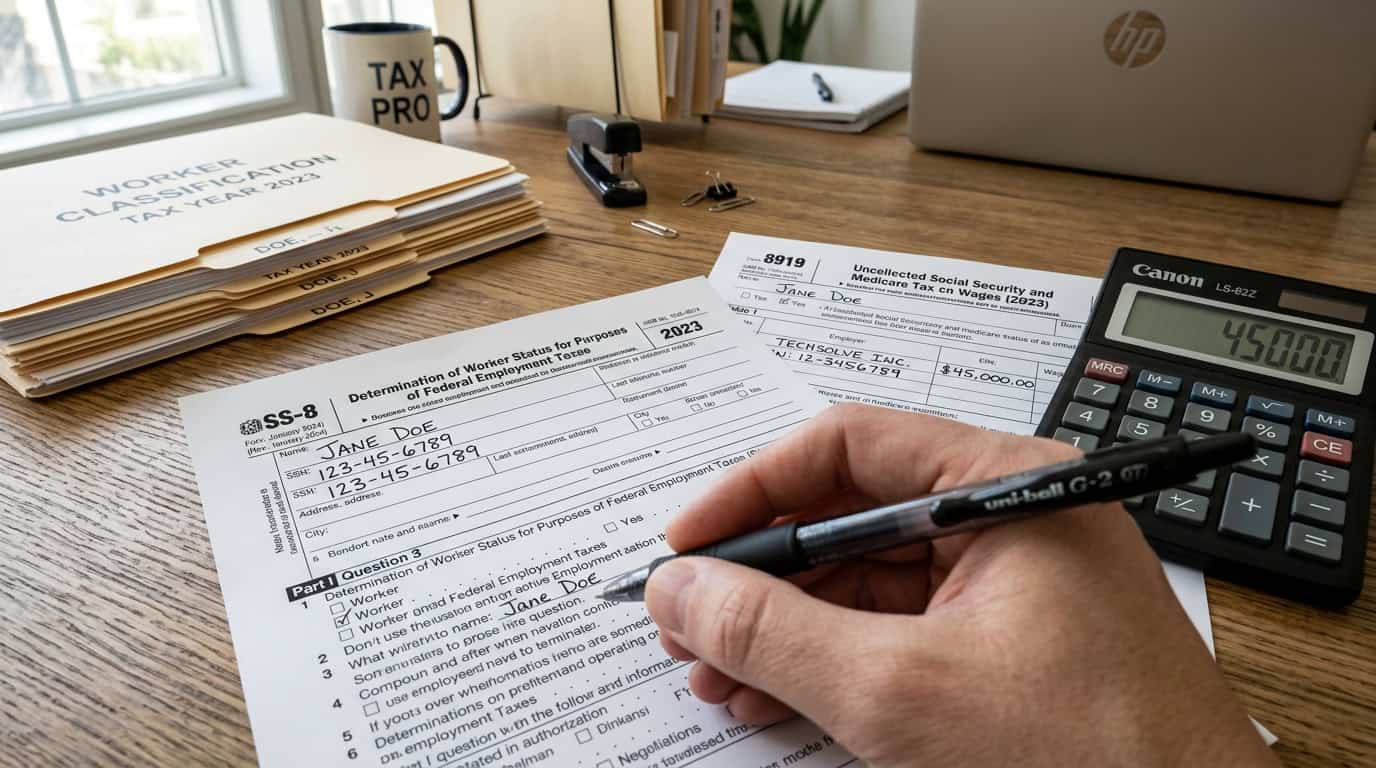
- File IRS Form SS-8 (“Determination of Worker Status for Purposes of Federal Employment Taxes”): Download Form SS-8 from IRS.gov. Complete the detailed questionnaire explaining how the company assigned your work, supervised your schedule, and provided instructions. Mail Form SS-8 to the designated IRS processing office. The IRS will review the operational facts, contact the business, and issue an official, binding determination letter.
- File IRS Form 8919 (“Uncollected Social Security and Medicare Tax on Wages”): When filing your annual federal tax return (Form 1040), attach Form 8919 using Reason Code G (“I filed Form SS-8 and have not received a reply”). This allows you to pay only your 7.65% employee portion of Social Security and Medicare taxes on your 1099 income, saving you 7.65% in unlawful self-employment taxes immediately while the IRS processes your determination.
- Amend Prior Years’ Returns (IRS Form 1040-X): Under Internal Revenue Code § 6511, you have up to three (3) years from the original filing date to amend past tax returns. Once the IRS confirms employee status under Form SS-8, file Form 1040-X with Form 8919 to claim full tax refunds for overpaid self-employment taxes in prior tax years.
Step 4: Filing with Your State Labor Commissioner & Unemployment Division
State labor departments often provide faster enforcement, stricter standards, and higher financial penalties than federal agencies. For instance, in California, the Labor Commissioner’s Office (DIR / DLSE) enforces the strict ABC test under Labor Code § 2775 and assesses civil penalties ranging from $5,000 to $25,000 per willful misclassification violation under Labor Code § 226.8.
- File a State Wage Claim: Submit an individual wage claim for unpaid overtime, minimum wage shortfalls, liquidated damages, and waiting-time penalties through your state labor board portal.
- Notify the State Unemployment Insurance (UI) Tax Division: Contact your state unemployment insurance department (such as California EDD, New York Department of Labor, or Texas Workforce Commission). Report that the company is failing to report payroll and pay UI taxes for its workforce. State UI tax auditors conduct comprehensive payroll audits that force companies to reclassify entire teams.
Step 5: Post-Filing Follow-Up & Archiving Case Records
Federal and state investigations require several months. Maintain an organized case tracking file to document every agency communication, investigator name, and certified mail delivery.
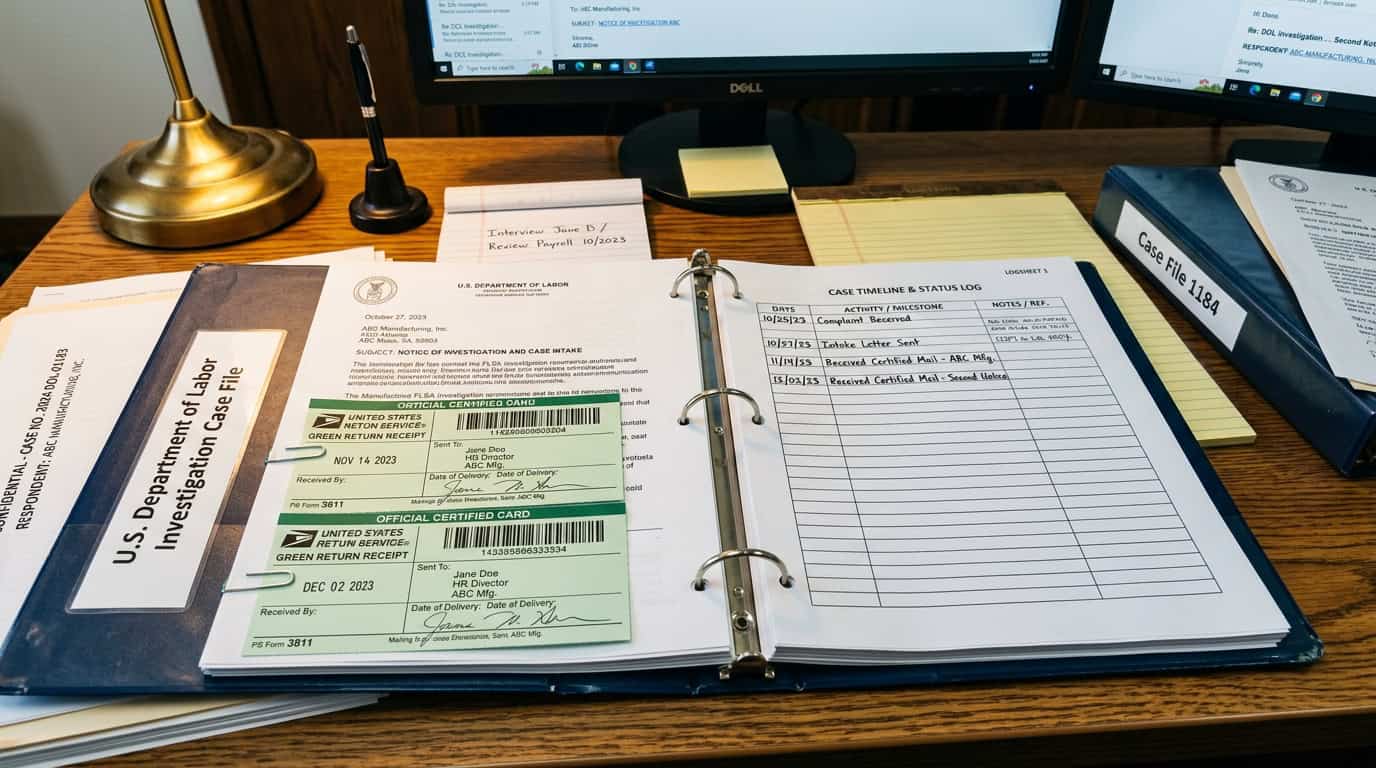
Evidence Preparation Checklist & Statutory Filing Windows
Adhere to strict statutory filing deadlines. Under the FLSA (29 U.S.C. § 255), you have two years from the date of an unpaid wage violation to file a legal claim, extended to three years if the employer acted willfully. Waiting too long permanently bars your financial recovery.
1099 Misclassification Document Checklist & Deadlines
2 years standard under 29 U.S.C. § 255; 3 years for willful violations where the employer knew or showed reckless disregard for classification rules.
Up to 3 years from tax filing date to file Form 1040-X and recover overpaid 7.65% self-employment taxes under IRC § 6511.
Save email directives, mandatory shift schedules, uniform receipts, company handbooks, and customer communication guidelines.
FLSA Section 15(a)(3) strictly protects workers against firing, shift reduction, or wage cuts for reporting wage theft or filing complaints.
For state-specific wage limits and civil filing deadlines across all 50 states, consult the 50-State Small Claims Limits & Statute of Limitations Calculator.
Formal Statutory Demand & Reclassification Notice Template
If you choose to demand direct reclassification and back overtime pay from your employer before filing an administrative claim, transmit this formal pre-litigation demand via USPS Certified Mail with Return Receipt Requested.
DATE: [Date of Notice]

VIA USPS CERTIFIED MAIL RETURN RECEIPT REQUESTED
CERTIFIED MAIL TRACKING #: [Insert USPS Tracking Number]

TO EMPLOYER ENTITY:
[Company / Business Name]
Attn: Payroll, Human Resources, and Managing Executives
[Company Street Address]
[City, State, ZIP]

FROM WORKER:
[Your Full Legal Name]
[Your Mailing Address]
[City, State, ZIP]
[Telephone Number]
[Email Address]

SUBJECT: FORMAL NOTICE OF WORKER MISCLASSIFICATION, DEMAND FOR UNPAID OVERTIME WAGES, AND STATUTORY LIQUIDATED DAMAGES UNDER THE FAIR LABOR STANDARDS ACT (29 U.S.C. § 201 ET SEQ.)

Dear Managing Executives and Payroll Officers:

I am writing to provide formal notice of ongoing wage violations resulting from my unlawful classification as an independent contractor rather than an employee under the Fair Labor Standards Act (FLSA), 29 U.S.C. § 201 et seq., and applicable state labor statutes.

1. STATUTORY EMPLOYEE STATUS UNDER ECONOMIC REALITIES:
Throughout my tenure with [Company Name] from [Start Date] to the present, the company has exercised pervasive operational, behavioral, and financial control over my daily work. Specifically:
a. The company sets my mandatory shift hours, schedules, and daily performance tasks;
b. The company supervises my work methods, issues operational guidelines, and requires adherence to internal company policies;
c. The work I perform is an integral, essential component of the company's core commercial operations;
d. I have made no independent capital investment in commercial facilities or separate business infrastructure; and
e. I am economically dependent on [Company Name] and do not operate an independent trade or business serving competing clients.
Under federal law (29 CFR Part 795) and applicable state tests, I am a statutory employee entitled to all protections of the FLSA.

2. UNPAID OVERTIME AND MINIMUM WAGE LIABILITIES:
As a result of this unlawful 1099 classification, [Company Name] failed to record my actual hours worked and failed to pay the mandatory one-and-one-half (1.5x) regular rate for hours worked in excess of forty (40) per workweek pursuant to 29 U.S.C. § 207.
Based on contemporaneous records:
- Total Estimated Overtime Hours Worked: [Total Number of Overtime Hours] hours
- Regular Hourly Rate: $[Hourly Rate]/hour (Overtime Rate: $[Overtime Rate]/hour)
- Total Unpaid Overtime Compensation Due: $[Total Unpaid Overtime]
- Unreimbursed Necessary Business Expenses: $[Total Expenses]
TOTAL UNPAID COMPENSATION DEMANDED: $[Total Unpaid Wages]

3. STATUTORY LIQUIDATED DAMAGES & TAX LIABILITIES:
Pursuant to 29 U.S.C. § 216(b), an employer who violates federal overtime and minimum wage provisions is liable for the full amount of unpaid wages plus an EQUAL AMOUNT (100%) in statutory liquidated damages, alongside reasonable attorney fees and costs.
Under federal tax law, the company has also failed to withhold and pay its statutory 7.65% employer share of FICA taxes, unlawfully shifting this tax burden onto my personal tax filings.

FORMAL DEMAND FOR RESOLUTION:
I hereby demand that [Company Name] take the following actions within FOURTEEN (14) CALENDAR DAYS of receipt of this notice:
1. Reclassify my position as a W-2 employee retroactively;
2. Issue payment in the amount of $[Total Amount] covering all unpaid overtime wages and statutory liquidated damages; and
3. Provide an itemized accounting of all hours worked and remit corrected payroll records.

NOTICE OF ANTI-RETALIATION PROTECTIONS:
Be advised that 29 U.S.C. § 215(a)(3) strictly prohibits any discharge, demotion, suspension, shift reduction, or other adverse action against an employee for asserting statutory rights under the FLSA. Any retaliatory act will result in immediate escalation to the U.S. Department of Labor Wage and Hour Division and federal court action seeking punitive damages.

Sincerely,

__________________________________________
[Your Full Legal Name]
[Title / Role with Company]
Common Myths vs. Legal Realities About 1099 Classification
Employers frequently rely on legal misconceptions to convince workers that they have no right to overtime or employee protections.
Myth vs. Legal Reality: Independent Contractor Rights
REALITY: Private employment contracts cannot override federal or state labor statutes. Under the FLSA, employee status is determined by economic realities and actual employer control, regardless of what contract labels the employer chose to write.
If an employer dictates your working hours, sets your assignments, and directs your daily tasks, you are an employee entitled to 1.5x pay for all hours worked over 40 per week, plus 100% liquidated damages.
REALITY: State unemployment agencies conduct independent classification audits. If you were misclassified, the state will reclassify your wages and award full unemployment benefits while penalizing the employer for unpaid taxes.
Filing IRS Form SS-8 and Form 8919 forces the employer to pay their mandatory 7.65% FICA payroll tax share and allows you to amend prior tax returns for substantial tax refunds.
Frequently Asked Questions
Can my employer fire me for filing a 1099 misclassification complaint?
No. Under Section 15(a)(3) of the Fair Labor Standards Act (29 U.S.C. § 215(a)(3)), it is unlawful for any employer to discharge, demote, suspend, or in any other manner discriminate against any employee because they have filed a complaint or instituted any proceeding under the FLSA. If an employer retaliates, the Department of Labor or a civil court can order immediate reinstatement, payment of lost wages, and substantial emotional distress and punitive damages.
How much money can I recover if I was misclassified as an independent contractor?
Misclassified workers can recover: (1) All unpaid overtime premiums at 1.5 times their regular hourly rate for hours worked over 40 in any workweek; (2) Minimum wage shortfalls if contract pay dipped below statutory hourly minimums; (3) An equal amount (100%) in statutory liquidated damages under 29 U.S.C. § 216(b); (4) A 7.65% refund on overpaid FICA payroll taxes through IRS Form 8919; and (5) State law waiting-time and meal/rest break penalties where applicable.
How far back can I claim unpaid overtime wages?
Under the federal FLSA statute of limitations (29 U.S.C. § 255), you can recover back pay for up to two (2) years prior to filing your complaint. If the employer’s misclassification was “willful”—meaning they knew their classification violated labor laws or showed reckless disregard for classification rules—the statute of limitations extends to three (3) years. In several states, such as California and New York, state wage claims can reach back three to six years.
What happens when I submit IRS Form SS-8?
Upon receiving Form SS-8, the IRS assigns an agent to review the behavioral and financial facts of your work arrangement. The IRS sends a formal inquiry questionnaire to the business requiring them to answer detailed questions regarding control and supervision under penalty of perjury. After evaluating both responses, the IRS issues an official, binding determination letter. If the IRS rules you were an employee, the business is assessed for unpaid employer payroll taxes and penalties.
Official Agency Directory & Primary Statutory Citations
- U.S. Department of Labor Wage & Hour Division (WHD): Official FLSA worker complaint intake portal: dol.gov/agencies/whd/contact/complaints | National Toll-Free Hotline: 1-866-487-9243 (1-866-4-USWAGE).
- Internal Revenue Service (IRS): Form SS-8 Worker Status Determination & Form 8919 Uncollected FICA Taxes: irs.gov/forms-pubs/about-form-ss-8.
- Fair Labor Standards Act (FLSA): 29 U.S.C. § 201 et seq.; 29 U.S.C. § 207 (Maximum Hours and Overtime); 29 U.S.C. § 216(b) (Damages & Attorney Fees); 29 U.S.C. § 255 (Statute of Limitations).
- DOL Final Rule on Independent Contractor Status: 29 CFR Part 795 (Economic Reality Test Factors and Totality of Circumstances Standard).
- California Labor Commissioner’s Office (DIR / DLSE): Independent Contractor vs. Employee Standard (AB 5 / Labor Code § 2775 & Labor Code § 226.8): dir.ca.gov/dlse/.
This guide was produced with AI-assisted research and drafting, then reviewed and edited by the site owner against the primary government and statutory sources linked on this page. AI output may contain errors. Readers should verify deadlines and filing requirements through the linked official agency sources before acting. Self-help templates have not been reviewed by a licensed attorney.
HowToReport.org is an independent educational site — not a government agency. We link to official .gov and .org sources, but we cannot file a complaint for you or give legal advice. Read our full Legal Disclaimer & Safe Harbor →
Damages Under ,000? Check Your State Small Claims Limit
If administrative complaints fail to recover your financial losses, you can sue in local small claims court without expensive attorney fees. Select your state below for instant dollar limits and statutory deadlines:
Related Statutory Reporting Guides & Citizen Protections
Official step-by-step reporting protocols in this regulatory category.
What happens next
- Most agencies send an acknowledgment or reference number — save it with your copies.
- Investigations vary by agency; complex cases can take weeks or months.
- If you do not hear back within the timeframe listed on the agency site, follow up in writing.
- Keep reporting to additional agencies if your issue crosses categories (for example, fraud plus billing).